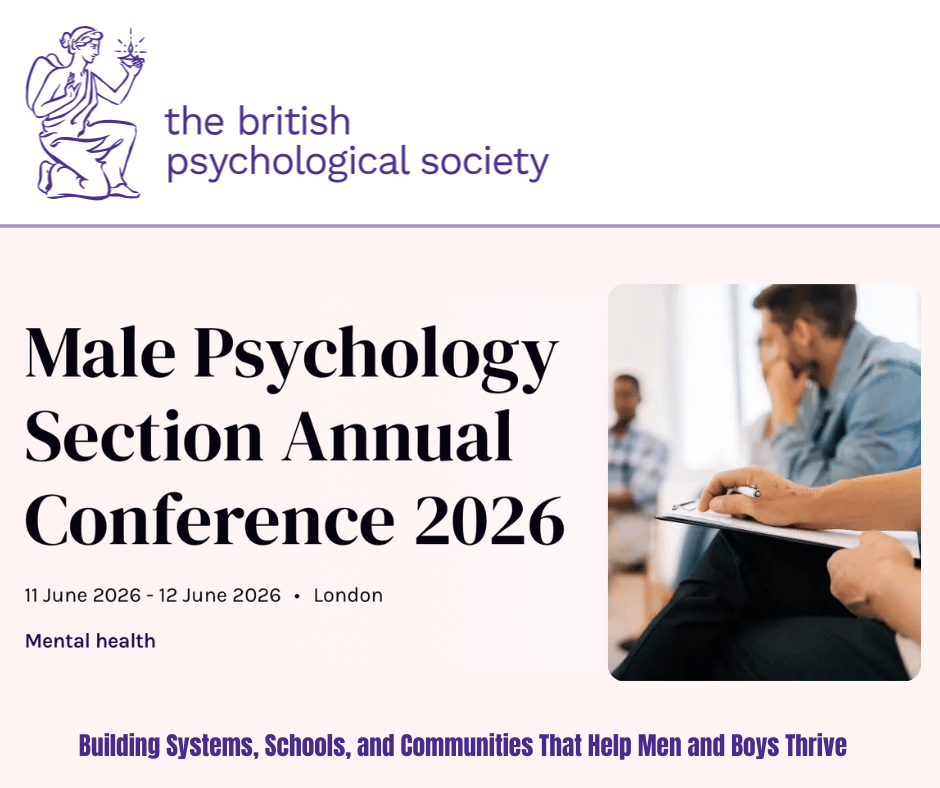
I’m honored to be presenting at the British Psychological Society (BPS) Male Psychology Section Annual Conference 2026 this June.
The BPS is the professional body representing psychologists in the United Kingdom, and the Male Psychology Section focuses specifically on advancing research and practice related to men’s mental health, wellbeing, identity, and the unique challenges men face across the lifespan.
My presentation will introduce a framework from my ongoing research on fatherhood identity and the psychological impact of prolonged parent–child separation.
My presentation topic
“Psychological Fatherhood Under Constraint: Innovations for Maintaining Paternal Identity When Systems Separate Fathers and Children.”
The session explores what happens psychologically when fathers remain deeply connected to their children but external systems limit or interrupt contact.
Situations such as high-conflict separation, parental alienation dynamics, migration restrictions, or prolonged court processes can leave fathers in a difficult psychological position. The internal identity of being a father continues, while the ability to live that role day-to-day may be severely restricted.
My talk will focus on:
✓ The psychological importance of paternal identity in men’s mental health
✓ The concepts of ambiguous loss and disenfranchised grief in separated fathers
✓ How prolonged separation can disrupt identity, meaning, and future orientation
✓ Practical counseling approaches that help fathers maintain psychological stability and connection
I will also introduce a framework of identity-preserving strategies that clinicians can use to help fathers navigate periods of enforced separation while remaining emotionally engaged in their role as parents.
Why this work matters
Fatherhood is one of the most meaningful roles many men will ever hold. When that role is disrupted or constrained, the psychological consequences can be profound.
In my work with fathers around the world, I see the emotional toll that prolonged separation can take. Supporting fathers’ mental health during these periods is not just about helping men cope—it also helps protect children by keeping fathers stable, engaged, and psychologically present.
Research and clinical practice are only beginning to address these issues directly, and I’m grateful for the opportunity to contribute to this growing conversation within the field of male psychology.
I look forward to sharing ideas with fellow psychologists, researchers, and practitioners working to better understand and support men’s mental health.