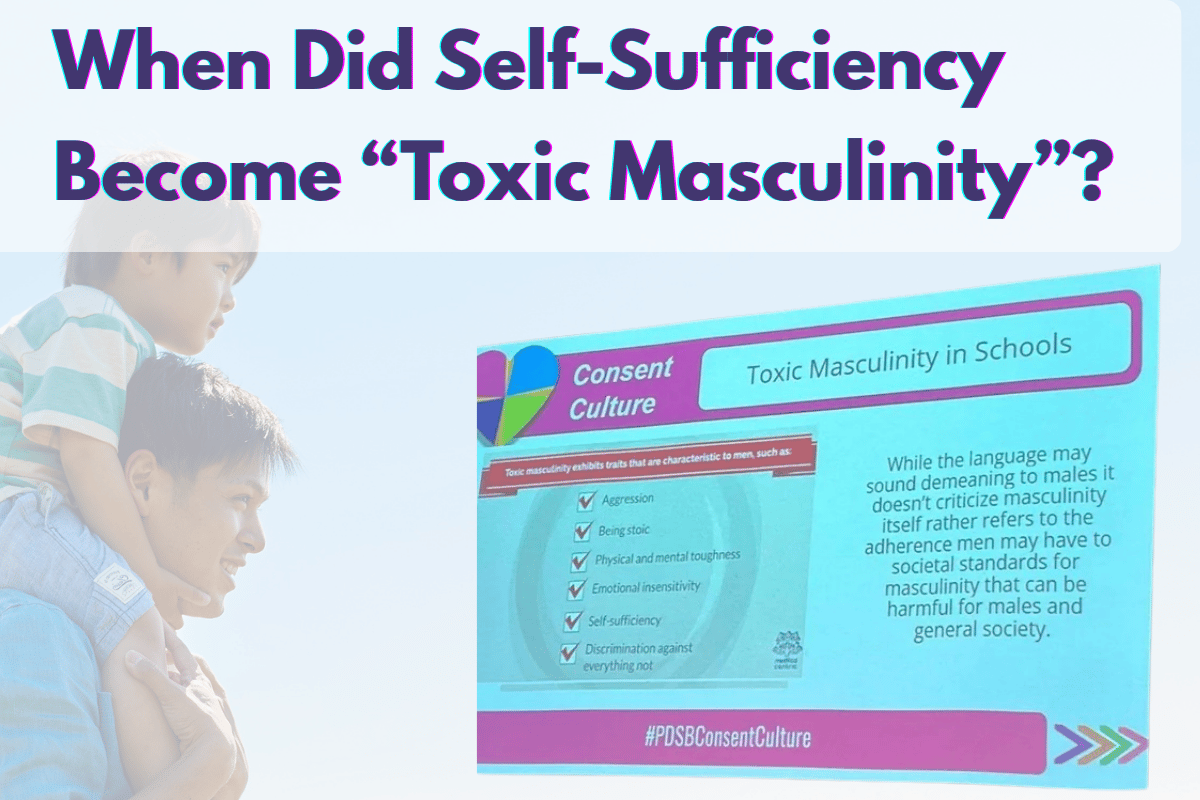
A presentation bearing the Peel District School Board’s “Consent Culture” branding recently included a slide titled Toxic Masculinity in Schools.
Among the characteristics listed were aggression, being stoic, physical and mental toughness, emotional insensitivity, self-sufficiency, and discrimination.
Some of these concepts are relatively straightforward. Aggression can become harmful. Emotional insensitivity can interfere with healthy relationships. Discrimination harms both individuals and communities.
But other items deserve considerably more nuance.
Stoicism. Mental toughness. Self-sufficiency.
From a mental health perspective, the important question is not simply whether a person possesses these characteristics. It is how those characteristics are expressed, why they are being used, and whether they are helping or harming the individual.
Labeling potentially adaptive characteristics as inherently unhealthy risks confusing emotional strength with emotional avoidance—and independence with isolation.
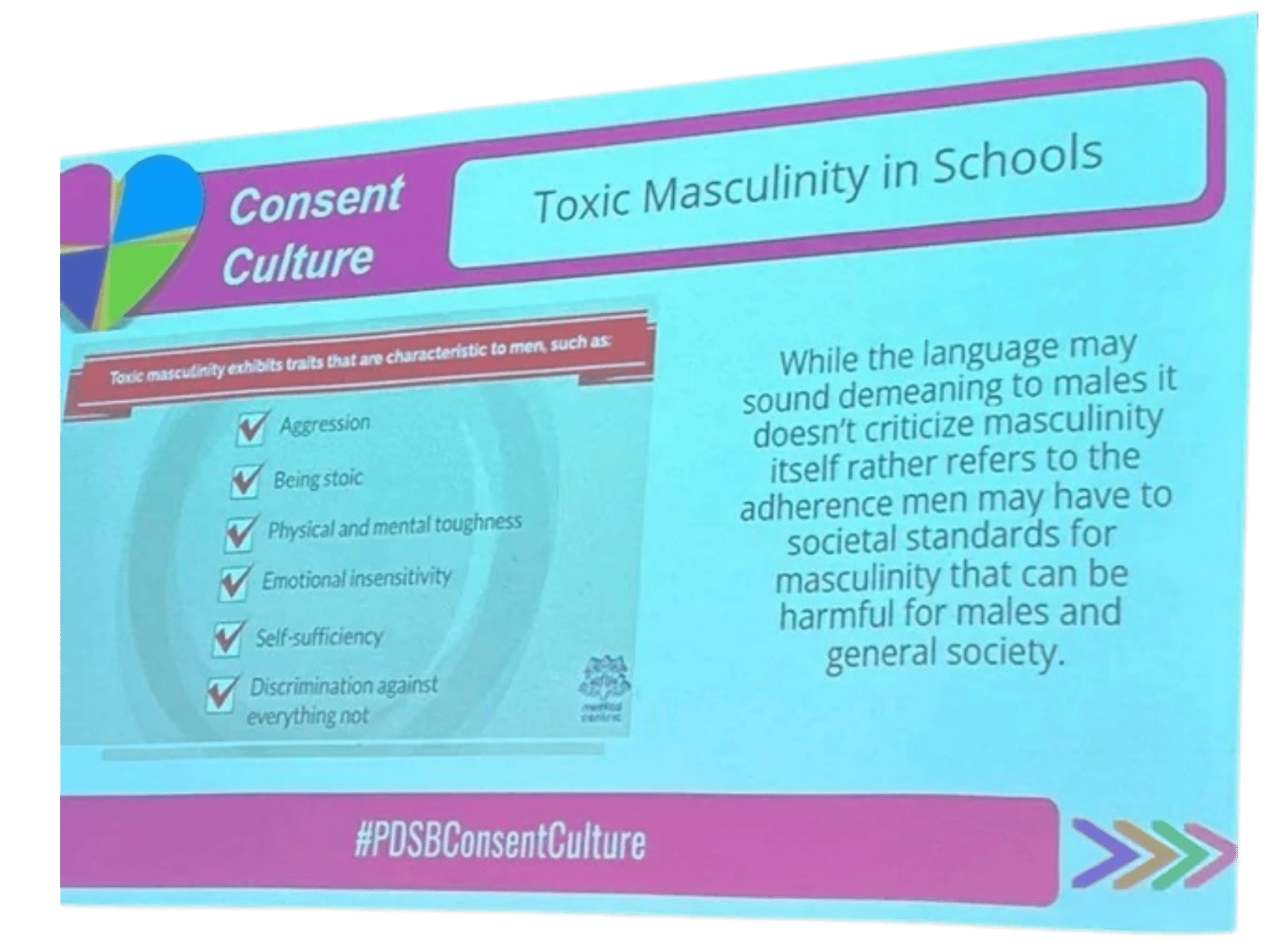
Photo from Peel District School Board, Ontario, Canada (Source)
Self-sufficiency and healthy autonomy
Developing greater independence is a normal and important part of growing up.
Self-sufficiency can mean learning how to prepare your own meals, manage responsibilities, pursue employment, solve everyday problems, or make decisions without requiring someone else to continually provide direction.
Psychologically, there is an important difference between being capable of functioning independently and believing you must always function alone.
A self-sufficient person can still seek advice, accept support, rely on friends and family, participate in relationships, and ask for professional help.
Those behaviors are not incompatible with independence.
Healthy self-sufficiency gives someone another option: I can ask for help when I need it, but I also trust my ability to handle many of life’s challenges myself.
That sense of capability is something we should want young people to develop.
Mental toughness and resilience
“Mental toughness” can certainly become problematic when it is interpreted as never show emotion, never admit you’re hurting, and never ask for help.
But that is only one interpretation of the concept.
Mental toughness can also describe persistence, distress tolerance, emotional regulation, resilience, and the ability to continue functioning during difficult circumstances.
Children eventually become adults who will experience rejection, grief, relationship difficulties, financial pressures, professional setbacks, disappointment, and failure.
Good mental health does not mean eliminating these experiences or eliminating the difficult emotions that accompany them.
It means developing a range of strategies for navigating them.
Sometimes the healthiest response is asking someone for help. Sometimes it is allowing yourself to grieve. Sometimes it is changing an unhealthy situation.
And sometimes it is recognizing that a situation is temporarily difficult and finding the internal resources necessary to persevere.
Young people should be equipped for all of those possibilities.
Stoicism versus emotional suppression
Being stoic is frequently equated with suppressing emotion, particularly when discussing boys and men. But emotional regulation and emotional suppression are not the same thing.
There are certainly circumstances in which repeatedly denying, concealing, or avoiding emotions can become unhealthy.
There are also circumstances in which regulating an immediate emotional response is highly adaptive.
Consider someone who must work alongside a colleague who creates considerable stress. They may not be able to change the other person’s behavior or immediately leave their job.
Learning to regulate their response, concentrate on what they can control, and continue meeting their responsibilities can be a valuable coping strategy.
The philosophical tradition of Stoicism goes further than simply “not showing emotion.” Among its central ideas is distinguishing between what is within our control and what is not, and directing our efforts accordingly.
That does not require someone to tolerate abuse, remain silent indefinitely, or avoid seeking help.
It simply provides another framework through which a person can navigate adversity.
Healthy traits can have unhealthy extremes
Perhaps the larger issue is the tendency to classify complex human characteristics as either healthy or unhealthy without considering context.
Many positive psychological characteristics can become problematic at their extremes.
Self-sufficiency can become isolation.
Perseverance can become an inability to walk away.
Confidence can become arrogance.
Emotional openness can become poor emotional boundaries.
Stoicism can become emotional suppression.
Mental toughness can become denial of genuine psychological distress.
But the existence of an unhealthy extreme does not necessarily make the underlying characteristic unhealthy.
The better question is whether a particular behavior is helping someone build a healthy, functional life—or preventing them from doing so.
Boys need a broader emotional toolkit
Discussions about masculinity and mental health have helped draw attention to genuine problems, including situations in which boys and men feel unable to express vulnerability or seek psychological support.
Those conversations matter.
But expanding the emotional toolkit available to boys should mean adding options, not taking others away.
A boy can learn to express sadness and develop resilience.
He can ask for help and become self-sufficient.
He can be vulnerable with people he trusts and remain composed when circumstances demand it.
He can learn empathy while also learning perseverance.
These are not competing models of emotional health.
The goal should be psychological flexibility: developing enough emotional and practical skills to respond appropriately to different circumstances rather than believing there is only one acceptable way to cope.
Schools, parents, counselors, and other adults all play a role in helping children build that toolkit.
We should be cautious about teaching boys that traditionally masculine characteristics are inherently healthy simply because they are masculine.
But we should be equally cautious about teaching them that those characteristics are inherently unhealthy for the same reason.
The healthier approach is to teach boys when these qualities can serve them, when they can become harmful, and how to recognize the difference.